Stellantis
Designing a scalable digital ecosystem across vehicle discovery, configuration, purchase and ownership.
A multi-brand automotive platform designed to support complex customer journeys, reusable interface patterns and country-specific content across the Stellantis ecosystem.
More than a configurator: one connected automotive lifecycle.
The platform had to support multiple layers of customer decision-making — from vehicle discovery and stock availability to configuration, financing, trade-in, services, checkout, delivery and ownership.
Every stage introduced different product states, commercial rules and content requirements. The challenge was to make these journeys understandable while maintaining consistency across brands, markets and customer scenarios.
Multi-brand
A shared product foundation supporting multiple automotive identities.
End-to-end journey
Discovery, configuration, purchase, delivery and vehicle ownership.
Multi-market
Country-specific content, currencies, financing and commercial conditions.
Connected prototypes
Extensive interactive flows covering primary paths and edge cases.
Continuous validation
Maze user testing, weekly reviews and iterative refinement.
1+ year
Continuous involvement across product design, system evolution and delivery.
Buying a vehicle online is not a standard e-commerce journey.
Customer types
Private and business pricing conditions.
Vehicle variability
Models, trims, engines, colors, wheels, availability and delivery.
Commercial logic
Financing, trade-in, services, accessories and country-specific information.
Lifecycle states
Saved, configured, ordered, in production, delivered and activated.
One experience across the entire vehicle lifecycle.
Discover
Marketing pages, model exploration and comparisons
Search
Stock vehicles, filters, availability and pricing
Configure
Trim, engine, color, wheels and personalization
Finance
Customer type, instalments and financial details
Purchase
Basket, trade-in, services, delivery and checkout
Track
Order status, production, delivery and activation
Own
Vehicle controls, trips, goals, subscriptions and services
Desktop: scroll horizontally to follow the full lifecycle
One scalable system for multiple automotive brands.
I was responsible for the scalable design-system foundation used across the platform. The same UX structures and interface patterns had to support multiple Stellantis brands without recreating each customer journey from the beginning.
Brand-specific themes, assets and component properties could be updated centrally, making it possible to produce consistent variants while preserving each brand’s identity.
Core product logic
Shared component system
Brand layer
Market layer
The same components also had to support market-specific copy, currencies, financing details, legal information, availability and different content lengths without changing the underlying product structure.
Output
System
Shared structures for the platform foundation.
- 01system architecture
- 02shared components
- 03state coverage
Scalability
Reusable patterns that adapt across brands and markets.
- 01brand variants
- 02market flexibility
- 03content adaptability
Delivery
Patterns clear enough for product, client and technical alignment.
- 01product consistency
- 02implementation-ready specifications
- 03technical collaboration
The design system reduced repeated design work, improved consistency and enabled the team to adapt complex flows across brands and markets more efficiently.
Helping customers move from exploration to a viable vehicle choice.
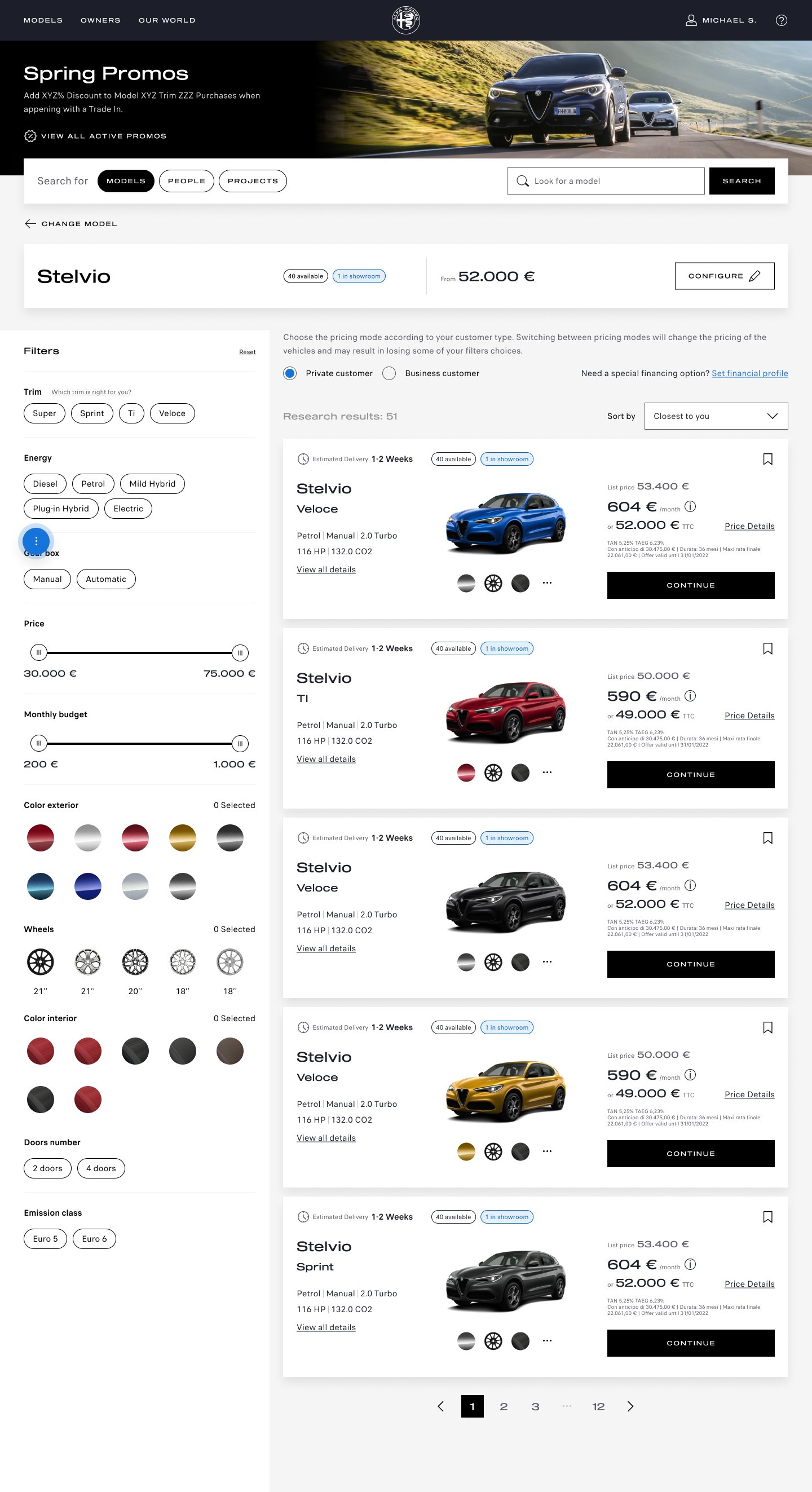
The discovery layer combined branded content, stock availability, product comparison and detailed filters. The interface had to help users narrow a large vehicle catalogue without losing essential commercial information.
Branded storytelling, comparisons, configuration entry points and test-drive journeys had to remain connected to practical commercial actions.

Managing complex product states without overwhelming the customer.
The configurator had to connect visual personalization, vehicle specifications, availability, pricing and financing while preserving the user’s progress throughout the journey.
Configuration state
Trim, engine, color and wheel selections remain visible and connected.
Real-time commercial context
Price, instalment and availability information update alongside configuration decisions.
Persistence
Users can save their configuration and continue into summary and checkout.
Decision hierarchy
Primary choices remain clear despite dense product and financial information.
Breaking a complex automotive checkout into understandable decisions.
The purchase flow combined trade-in, payment options, services, accessories, delivery and legal or financial information. Each section needed clear completion states while preserving a persistent summary of the configured vehicle and total cost.
Extending the experience beyond checkout.
After purchase, the experience continued through order tracking, production states, delivery and digital vehicle pre-activation. This created continuity between the commercial journey and the owner ecosystem.
Locked and available actions
Features become available according to the vehicle lifecycle.
Pre-activation & notifications
Customers can prepare digital services before receiving the vehicle, while important next steps remain visible.
Designing the platform after the vehicle becomes part of everyday life.
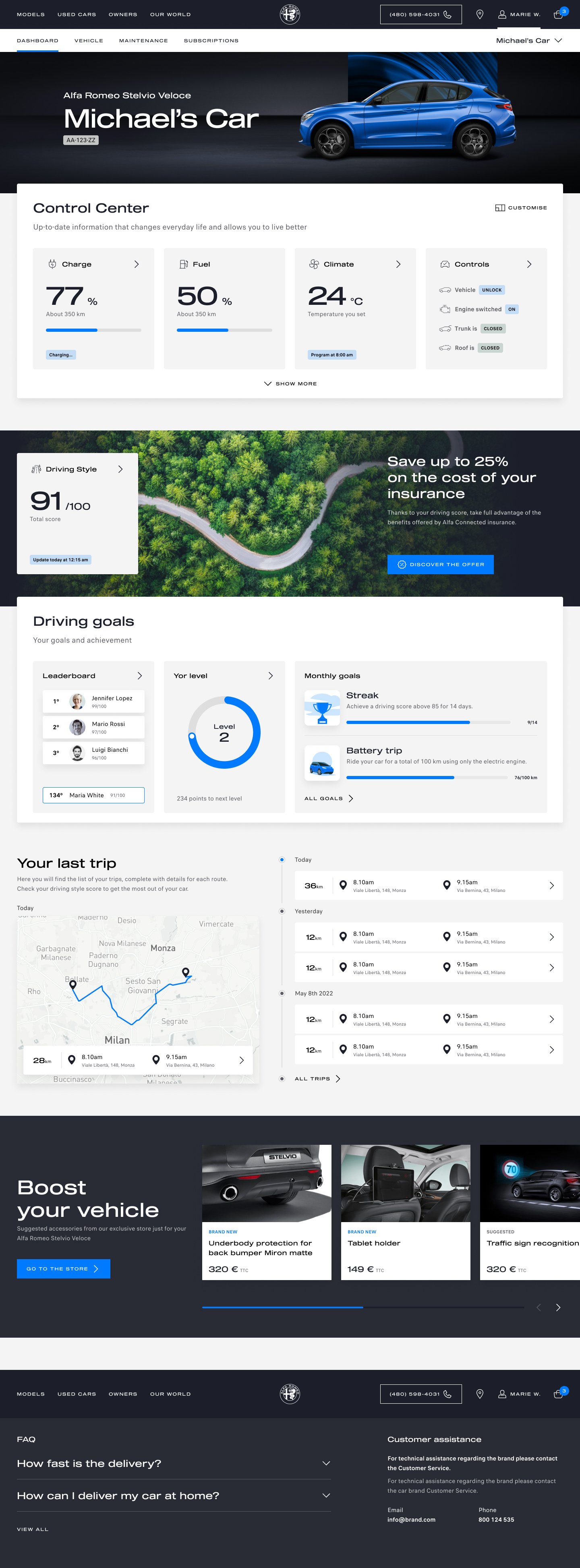
The owner dashboard brought vehicle status, remote controls, driving behavior, trip history, goals, services and commercial opportunities into one connected account experience.
- 01Control Center
- 02Driving insights
- 03Trip history
- 04Services and accessories
Selected dashboard concepts and evolving ownership modules explored during the project.
From connected prototypes to weekly product decisions.
Major screens were connected into interactive prototypes covering primary journeys, alternative paths and edge cases. This allowed the team to review product logic before implementation and provide realistic scenarios for testing and stakeholder presentations.
Interactive prototypes were used in Maze to evaluate navigation clarity, task comprehension and decision-making across complex automotive journeys.
Discovery
- 01model search
- 02vehicle details
- 03configuration
Configuration
- 01personalization
- 02save
- 03financing
- 04summary
Purchase
- 01trade-in
- 02services
- 03delivery
- 04checkout
Post-purchase
- 01tracking
- 02pre-activation
- 03owner dashboard
Hundreds of connected paths were used to cover realistic customer scenarios and reduce ambiguity before development.
Findability
Could users locate the right model, configuration or next action?
Comprehension
Were pricing, financing, availability and completion states understandable?
Task flow
Could users move through configuration and purchase without losing context?
Findings were translated into interface refinements, clearer hierarchy and more consistent reusable patterns before implementation.
Define
Requirements, scenarios and sprint priorities
Design
Flows, interfaces and design-system updates
Prototype
Connected journeys and edge cases
Test & Review
Maze testing, internal critique and stakeholder feedback
Present
Weekly client and stakeholder presentation
Refine
Decisions, documentation and implementation support
- 01DefineRequirements, scenarios and sprint priorities
- 02DesignFlows, interfaces and design-system updates
- 03PrototypeConnected journeys and edge cases
- 04Test & ReviewMaze testing, internal critique and stakeholder feedback
- 05PresentWeekly client and stakeholder presentation
- 06RefineDecisions, documentation and implementation support
- Repeat with the next sprint
Workshops, Maze testing and stakeholder reviews continuously informed the next sprint, helping align business requirements, clarify complex journeys and create shared decisions across teams.
Senior product-design responsibility across systems, journeys and delivery.
Systems
- 01Design-system ownership: Maintaining a scalable shared foundation across brands and flows.
- 02UX architecture: Structuring complex journeys, information and decision points.
- 03Multi-market content: Supporting different countries, languages and content conditions.
Experience
- 01UI design: Creating polished and consistent web interfaces.
- 02Interactive prototyping: Connecting flows, product states and edge cases.
- 03User testing: Preparing and refining Maze-based usability tests.
Delivery
- 01Workshops: Supporting collaborative definition and decision-making.
- 02Stakeholder presentations: Presenting weekly sprint outcomes to clients and stakeholders.
- 03Developer collaboration: Preparing implementation-ready patterns and iterating with technical teams.
Reusable foundations across the automotive lifecycle.
Consistency
Shared patterns across brands and product areas.
Scalability
Reusable structures for new brand and market variants.
Clarity
More understandable decisions across complex customer journeys.
The work established reusable patterns across discovery, purchase and ownership, making complete journeys easier to adapt across brands and markets.
Designing enterprise products means designing systems of decisions.
This project reinforced the importance of scalable foundations, edge-case coverage and continuous alignment when designing real-world purchasing experiences.
The strongest design decisions were not isolated screens, but reusable structures that could support different brands, markets, states and moments in the customer lifecycle.
Need a scalable product system across complex flows and teams?
I help companies structure complex journeys, reusable interface systems and implementation-ready product experiences.
Roche
Internal healthcare workflows